The gap between raw talent and a professional podium isn't measured in horsepower; it's calculated in cognitive load and data fidelity. You've likely felt the frustration of stagnating lap times despite endless track sessions. You've stared at complex telemetry that remains a digital enigma. Standard track days aren't enough to break into the elite tiers of motorsport. To reach the grid in Formula E or F1, you need a sophisticated high performance racing driver training program that treats speed as a deliberate architecture rather than a lucky reflex.
We understand that the transition to professional mastery requires more than just seat time; it demands a strategic alignment of technical precision and commercial intelligence. You'll discover the exact protocols used by elite teams to sharpen cognitive performance and decode F1-level data. This guide provides a clear roadmap to navigate the complex licensing requirements and technical standards of 2026. We'll examine how high-fidelity simulators and AI-driven strategy are redefining the path from the paddock to the professional circuit.
Key Takeaways
- Distinguish between recreational track days and the engineered precision required for elite motorsport performance.
- Utilize high performance racing driver training to bridge the gap between high-fidelity digital simulation and on-track technical mastery.
- Analyze why technical speed isn't enough without a robust strategy for commercial alignment and sponsorship management.
- Adopt a professional roadmap that utilizes rigorous auditing and simulator-based refinement to secure your place in the paddock.
- Gain exclusive access to the mentorship protocols used by F1 veterans to transform talent into professional legacy.
Defining High Performance Racing Driver Training: Beyond the Track Day
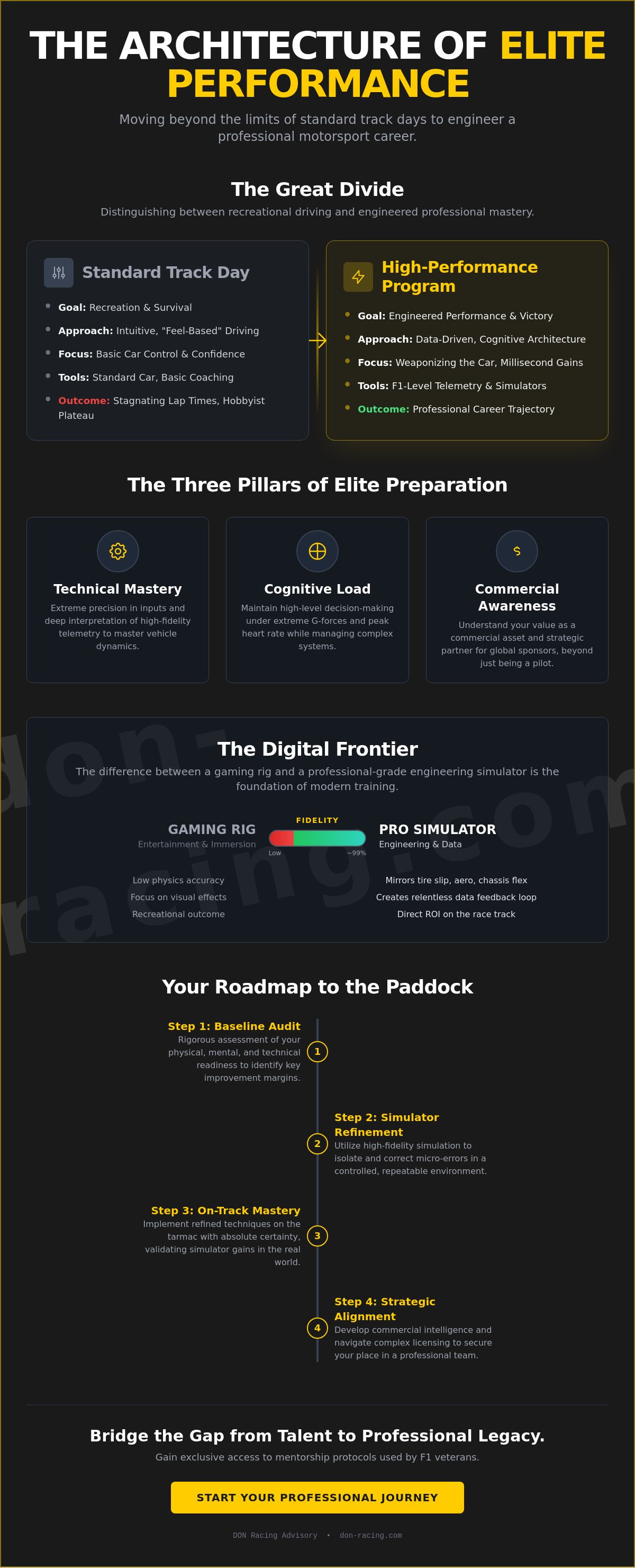
Speed is a commodity. Mastery is a strategy. Retail racing schools often focus on basic car control and building confidence behind the wheel, but elite high performance racing driver training operates on an entirely different plane. It's the difference between a hobbyist and a professional athlete. While a standard track day prioritizes survival and recreation, professional development prioritizes engineered performance. Every input is measured. Every millisecond is accounted for. The goal isn't just to drive fast; it's to weaponize the car through data fidelity and cognitive architecture.
The shift from intuitive driving to data-driven execution is absolute. At 300 km/h, intuition is too slow. You need a mental framework that allows you to process aerodynamic shifts, tire degradation, and strategic energy management simultaneously. This is why elite training must integrate you into the professional motorsport ecosystem. To enter the paddock of F1 or Formula E, you don't just need a license. You need to understand the driver development program structures that elite teams use to filter talent. This isn't a course. It's a strategic advisory that aligns your technical skills with the brutal demands of top-tier competition.
The Professional Development Philosophy
We've moved beyond the "retail" school model. A standard school provides a car and a coach for a day; bespoke advisory provides a roadmap for a career. This philosophy centers on elite mentorship. Training with access to the insights of veterans like Sébastien Buemi and Nyck de Vries offers perspectives that no textbook can replicate. These are drivers who've operated at the absolute pinnacle of the sport. Their guidance transforms your approach from "driving fast" to "executing a race." The process begins with a rigorous baseline assessment. We audit your physical readiness, mental resilience, and technical baseline to identify the specific margins where professional races are won or lost.
The Three Pillars of Elite Preparation
- Technical Mastery: This is the foundation. It involves extreme precision in inputs and a deep sense of mechanical sympathy. You'll learn to interpret high-fidelity telemetry to understand exactly how your actions translate into vehicle dynamics.
- Cognitive Load: Modern racing requires managing multi-function steering wheels and complex strategic calls while under intense G-forces. We train you to maintain high-level decision-making when your heart rate is at its peak.
- Commercial Awareness: A fast driver without a brand is a liability. A core component of modern high performance racing driver training is understanding your value as a commercial asset. You aren't just a pilot; you're a strategic partner for global sponsors.
The Digital Frontier: High-Fidelity Simulator Training and Data Analytics
The distinction between a gaming rig and a professional simulator is the difference between entertainment and engineering. In 2026, the digital frontier is the primary laboratory for high performance racing driver training. It's no longer a supplement to track time; it's the foundation. Professional-grade simulators provide a controlled, repeatable environment where variables like tire pressure, track temperature, and fuel load are isolated. This allows you to identify micro-errors that are invisible to the naked eye. A driver might feel they're at the limit, but the data often reveals a different story. The simulator creates a relentless feedback loop. You refine a specific technical input in the virtual space, validate the result through telemetry, and then implement that mastery on the tarmac with absolute certainty.
Fidelity is the currency of professional development. While consumer setups focus on visual immersion, professional simulators prioritize the physics of tire slip, chassis flex, and aerodynamic load. This level of technical depth mirrors the rigorous standards found in Purdue University's Motorsports Engineering program, where data is treated as the primary language of speed. When your digital environment matches the physical car's behavior with 99% accuracy, every hour spent in the sim translates directly to ROI on the track. If you're ready to move beyond recreational driving, investing in a bespoke Driver Development Program ensures your digital preparation meets professional standards.
Mastering Telemetry and Data Overlay
Data deconstruction is where races are truly won. You'll move beyond looking at simple lap times and begin analyzing the "squiggles" that define elite performance. By overlaying your braking points, throttle application, and steering angles against a reference lap from a driver like Nyck de Vries, you can pinpoint exactly where the professional finds time. It's a surgical process. You'll learn to see the gap between your current performance and the theoretical limit of the car. Telemetry fidelity is a measure of simulator accuracy. Without high fidelity, your data analysis is just a guess. With it, you have a blueprint for perfection.
Virtual Track Familiarization
Track time is a finite resource. It's expensive. It's limited by weather and regulations. Virtual rehearsal allows you to arrive at the paddock with your muscle memory already established. Whether you're preparing for the high-consequence concrete canyons of a Formula E street circuit or the high-speed aero-sectors of an F1 track, the simulator reduces your "learning time" to zero. You don't spend your first session finding the line; you spend it refining the setup. This psychological advantage allows you to push the limit from lap one, knowing exactly how the car will react at every apex.
Strategic Career Pathing: Why Technical Skill is Only Half the Race
Technical velocity is merely the price of admission. A persistent misconception in the paddock is that the fastest lap time automatically secures a professional seat. It doesn't. In the high-stakes environment of 2026, high performance racing driver training must evolve into a comprehensive strategic advisory. You aren't just a pilot. You are a high-value asset in a multi-billion dollar industry. Navigating the hierarchy from karting through GT series to the Formula E or F1 paddock requires a calculated roadmap. It demands a balance between on-track precision and off-track commercial viability.
Securing a seat in top-tier series requires more than technical mastery; it requires access to elite driver sponsorship opportunities. Without a robust financial framework and commercial alignment, even the most exceptional talent can find their career path blocked. Professional development means building a profile that resonates with global corporate partners. It’s about demonstrating ROI through visibility, technical feedback, and brand synergy. Speed gets you noticed. Strategy gets you signed.
The Driver as a Brand Asset
Your identity outside the cockpit is as critical as your telemetry inside it. Media training and professional photography are no longer luxuries; they're essential components of your professional arsenal. By utilizing high-end video production and photography, you create a "vortex of interest" that attracts sponsors and team principals alike. This visual narrative transforms you from a competitor into a brand ambassador. It provides the proof of concept that partners need to justify their investment in your journey toward professional motorsport mastery.
Mentorship and Advisory
Navigating the complex Formula 1 driver career path requires the "insider knowledge" that only comes from those who have conquered Le Mans or Monaco. For example, understanding the nuances of the FIA Super Licence requirements, such as accumulating 40 points over three seasons in eligible championships, is vital for long-term planning. Choosing the wrong series at a pivotal moment can derail a decade of preparation. This is where mentorship becomes your primary competitive advantage. A strategic advisor helps you avoid common pitfalls, ensuring you're in the right car, in the right series, at the exactly right time. This level of high performance racing driver training ensures your technical skill is backed by a professional legacy.
The Professional Roadmap: Transitioning from Development to the Paddock
The transition from an aspiring talent to a professional athlete is a surgical process. It requires more than just seat time; it demands a rigorous audit of every technical and psychological variable. This roadmap is where high performance racing driver training translates into tangible career momentum. It’s a multi-phase execution that bridges the gap between digital mastery and paddock presence. We don't just teach you to drive. We engineer your entry into the professional motorsport ecosystem through a calculated sequence of technical and commercial milestones.
Identifying "unconscious incompetence" is the first hurdle in the technical audit. These are the subtle flaws in braking modulation or weight transfer that only manifest under extreme competitive pressure. We use high-pressure decision-making drills to test mental resilience and establish clear Key Performance Indicators (KPIs) for the training cycle. For instance, achieving consistent lap times within 0.1% of a professional benchmark is a non-negotiable metric. Whether you're working toward an SCCA Novice Permit, which remains valid for two years, or preparing for an International Grade A competition license, the audit phase defines your professional baseline.
Phase 1: The Technical Audit
Precision begins with an honest assessment of your current limits. We deconstruct your driving technique to find the margins where seconds are lost. This includes mental resilience testing, where we simulate high-stress scenarios to see how your decision-making holds up when cognitive load is at its peak. By establishing data-driven KPIs, we ensure your development is measurable and results-oriented. This phase isn't about ego; it's about the methodical removal of technical weaknesses before they're exposed on the world stage.
Phase 2: The Commercial Launchpad
Technical speed is the foundation, but commercial alignment is the catalyst for a sustainable career. You need to position yourself where the decision-makers and team principals operate. Networking at events like exclusive motorsport hospitality Monaco allows you to engage with potential partners in a high-stakes environment. Your "Sponsorship Deck" must be a data-driven document of your progress, showcasing your technical evolution and brand potential. Securing a professional-tier seat requires this dual-threat approach of speed and strategy.
The final stage of the roadmap involves intensive on-track application. We utilize professional coaching to bridge simulator data with real-world physics, ensuring you can manage tire degradation and fuel loads while adhering to the 2026 FIA Appendix L regulations. This ensures you're prepared for the administrative, medical, and technical requirements of international competition. Series entry is the final step in the transition, followed by ongoing performance management to ensure you stay at the front of the grid. To begin this transition with elite guidance, explore our Driver Development Program and secure your professional future.
The DON Racing Advisory Approach: Mentorship from the F1 Frontline
Success at the highest level of motorsport is never accidental. It's the result of a meticulously engineered partnership. While others offer generic courses, DON Racing Advisory provides a strategic alliance designed to elevate talent into the professional stratosphere. Our high performance racing driver training is built on the reality of the grid, not the theory of a classroom. By aligning your development with a firm founded in Monaco by seasoned F1 professionals, you gain access to an ecosystem that most drivers only see from behind the catch fencing. This is where technical speed meets the calculated poise of a strategic consultancy.
The core of our approach is unparallelled mentorship. Accessing world-class insights from Sébastien Buemi and Nyck de Vries isn't just about learning lines; it's about understanding the psychological and technical nuances of winning in Formula E and the F1 paddock. These are active champions who provide real-time feedback on your simulator sessions and on-track performance. They understand the cognitive architecture required to manage energy systems and aerodynamic variables at 300 km/h. This level of elite access ensures that every hour of training is focused on the margins that define professional legacy.
Bespoke Development Programs
We don't believe in "retail" training models. Every Driver Development Program we design is tailored to the specific commercial and technical goals of the individual or their corporate sponsors. This bespoke framework integrates our professional Racing Simulators with intensive data analysis and high-end media production. By utilizing our Professional Video Production & Photography Packages, we document your technical evolution, creating a high-impact narrative for potential partners. This is supplemented by exclusive access to the DON Hospitality network, providing a prestigious platform for career networking with industry gatekeepers during the most iconic race weekends.
The Path Forward
The journey to the pinnacle of global motorsport requires a relentless commitment to precision. It begins with a professional driver development audit to establish your technical and cognitive baseline. This isn't a casual assessment. It's a rigorous deconstruction of your current performance to identify the exact path to professional mastery. If you possess the ambition to compete in Formula 1 or Formula E, the transition from talent to professional starts here. Initiate your audit today and secure your position within the elite motorsport hierarchy. Explore our professional Driver Development Program to align your career with the frontline of racing excellence.
Securing Your Place on the Professional Grid
Transitioning from a track-day enthusiast to a professional athlete requires a deliberate shift in perspective. Speed isn't just about reflex; it's a calculated architecture of data, cognitive resilience, and technical precision. You've discovered how high-fidelity simulators bridge the gap to reality and why a strategic commercial roadmap is vital for longevity in the paddock. Speed alone doesn't guarantee a seat in Formula E or F1. You need a framework that aligns technical mastery with professional brand synergy.
This holistic methodology is the foundation of elite high performance racing driver training. By leveraging professional-grade simulator integration and our exclusive Monaco-based strategic network, you gain an insurmountable competitive advantage. You'll receive direct advisory from F1 and Formula E Champions who've already conquered the world's most demanding circuits. The path to motorsport mastery is no longer an enigma; it's a managed process of refinement and networking.
It's time to move beyond the grandstands and claim your position at the front of the pack. Begin Your Professional Journey with DON Racing Advisory and transform your raw talent into a lasting professional legacy. The next chapter of your career starts at the apex.
Frequently Asked Questions
What is the difference between high performance driving and professional racing training?
High performance driving focuses on recreational car control and safety for track-day enthusiasts. Professional racing training is a strategic, data-driven development process aimed at competitive mastery and career longevity. It shifts the focus from intuitive speed to engineered performance and commercial alignment. While one is about the thrill of the drive, the other is about the architecture of a professional career.
How long does it take to complete a professional driver development program?
The timeline depends on your technical baseline and ultimate career trajectory. A technical audit can be completed in days, but a comprehensive program often spans multiple racing seasons to satisfy licensing requirements and achieve commercial maturity. It's a continuous cycle of technical refinement and strategic networking rather than a fixed-duration course. True mastery requires a multi-year commitment to the professional roadmap.
Can I start professional driver training if I have no previous racing experience?
You can initiate professional training with no prior experience, provided you possess the commitment to follow a rigorous audit process. Many elite programs begin by establishing foundational car control before moving into high-fidelity simulation. However, reaching the pinnacle of the sport requires a structured, multi-year roadmap. We begin by identifying your technical baseline and building the cognitive resilience necessary for top-tier competition.
Are simulators actually effective for training professional Formula 1 drivers?
Professional simulators are the cornerstone of elite racing preparation in 2026. They allow drivers to rehearse complex energy management and tire degradation strategies without the prohibitive costs of track time. When simulator fidelity reaches professional standards, the digital preparation translates directly to on-track results. It’s a controlled laboratory where you can identify micro-errors that are invisible during real-world sessions.
What role does sponsorship play in a driver’s professional development?
Sponsorship is the catalyst for professional progression and career sustainability. Technical speed is a prerequisite, but it's insufficient without the commercial backing to secure seats in elite series like Formula E or F1. Professional training must include building a brand profile that offers clear ROI to high-level corporate partners. We treat sponsorship as a strategic partnership that aligns your technical success with corporate visibility.
How do I obtain a professional racing license through a development program?
Obtaining a license involves meeting specific FIA or SCCA criteria through accredited training and competition milestones. For example, an SCCA Novice Permit requires completing an approved school and remains valid for two years. Professional programs guide you through these administrative, medical, and technical hurdles. We ensure you're eligible for international competition by managing the complex licensing points system required for elite series.
What kind of physical fitness is required for high performance racing training?
Elite high performance racing driver training requires exceptional cardiovascular endurance and specific neck strength to withstand sustained G-forces. Drivers must maintain a low heart rate under extreme cognitive load to ensure precise decision-making at high speeds. We treat physical fitness as a technical variable, much like tire pressure or fuel load. It's an essential component of your overall performance architecture.
How does DON Racing Advisory integrate media production into driver training?
We utilize Professional Video Production & Photography Packages to document every stage of your technical evolution. This creates a high-impact visual narrative that serves as a proof of concept for potential sponsors and team principals. It transforms your private development process into a public-facing brand asset. By documenting your journey, we provide the visibility necessary to attract elite partnerships and secure your professional future.